
Will you chip in to support our nonprofit newsroom with a donation today?
Yes, I want to support My MLTnews!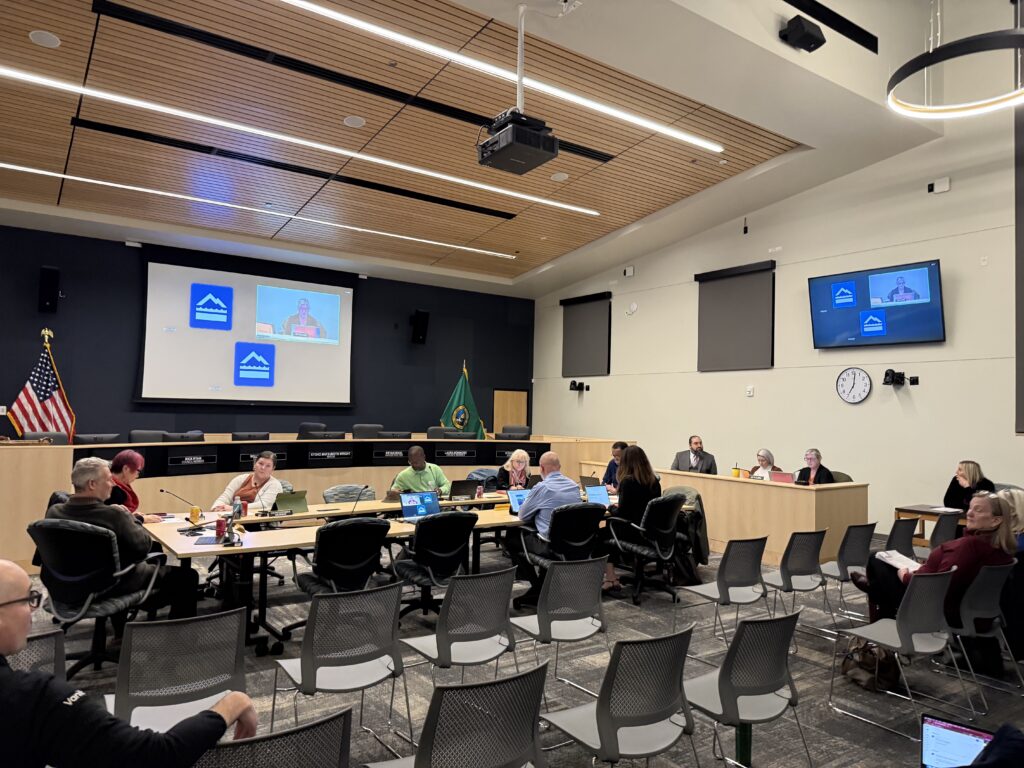
Key takeaways:
- The Council reviewed a proposed 1% property tax increase for 2026, adding about $2.84 annually for the average household.
- Third-quarter financials showed lower development and gambling revenues, delayed capital projects, and higher reimbursements from other governments.
- The Council reviewed a Housing Action Plan draft that breaks up the City’s housing goals into 42 actions and estimated timeline.
- Staff proposed 2026 fee updates, including new inspection fees, revised permit costs, recreation fee adjustments, and utility connection fee increases.
The Mountlake Terrace City Council convened Thursday for a meeting focusing on long-term planning documents, updates to city finances and proposed city fee schedules for 2026. Key items included a detailed review of the draft Housing Action Plan, the third-quarter financial report and a review of a proposed 1% increase in property taxes for 2026.
Financial reports and budget amendments
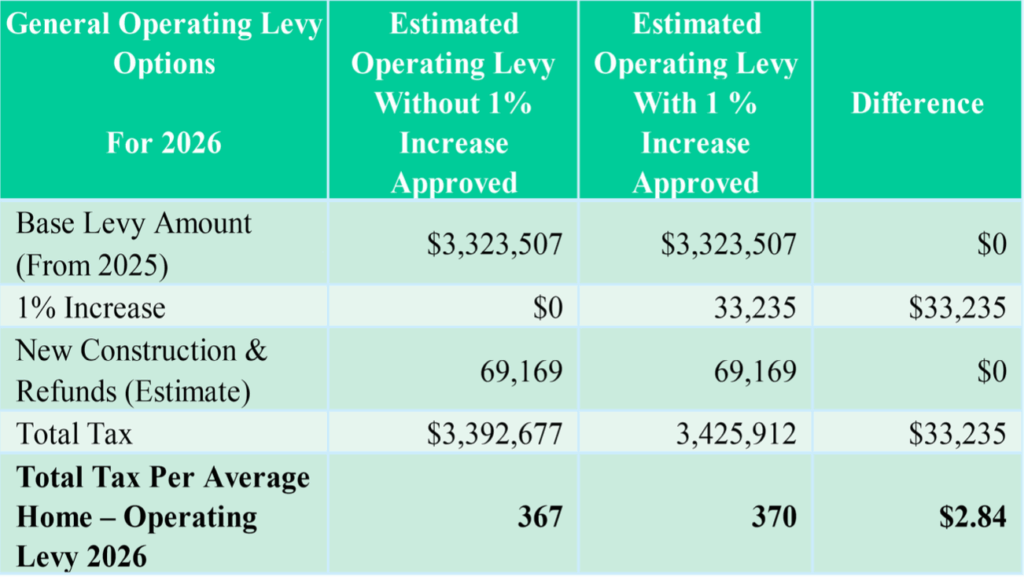
2026 levy: The Council reviewed an ordinance adopting a property tax levy for 2026. Staff recommended adopting the ordinance with a 1% increase in the regular property tax levy, the maximum permitted without using banked capacity. This 1% increase is estimated to yield an additional $33,235 for the City compared to 2025, ending with a total base levy amount of $3.42 million in 2026. This is estimated to increase annual property taxes for the average household by $2.84 over 2025, meaning the average household will pay about $370 in property taxes in 2026.
Third-quarter financial report: Finance Director Sirke Salminen and Financial Technician Caitland Reinke presented the third-quarter financial report for 2025, summarizing actual versus budgeted revenues and expenditures. Highlights of the report included:
- Lower-than forecasted development fees with 49% collected through the third quarter. Staff said this was because of uncertainty in the capital markets, with developers facing challenges securing financing for large projects.
- Gambling taxes are down due to the bankruptcy of a local casino, with 49% collected through September.
- Most remaining property tax revenues, historically collected in May and November, are expected in the fourth quarter.
- Several capital projects have been moved to the 2026 budget.
- The aquatics budget was lower than expected due to the closure of the Rec Center pool for maintenance.
- Reimbursements from other governments were up 43%. These mainly come from the City of Shoreline for fleet repairs done at the MLT facility.
- Capital improvements are lower than expected with delayed impact fees from upcoming development projects.
Biennial budget amendments: Following the third-quarter financial update, staff reviewed proposed biennial budget amendments for 2025-2026. The necessary modifications include adjusting beginning fund balances (which were approximately $4.7 million higher than originally forecasted in 2025), transferring funds to new funds approved by the council in October 2025, and revising the timing of capital projects, moving several from 2025 to 2026. A public hearing and a Council vote on the amendments are scheduled for Nov. 20.
Housing Action Plan
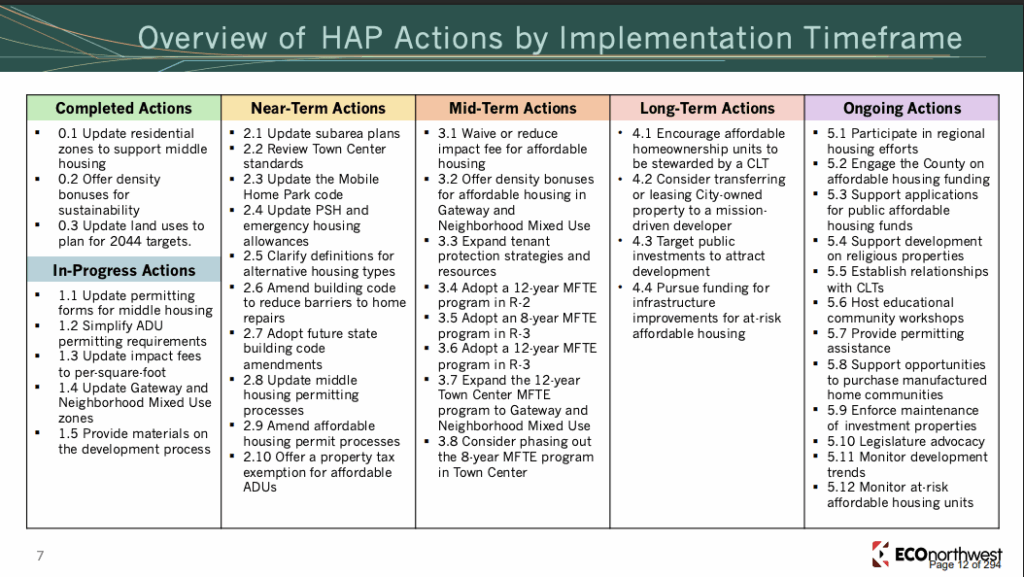
The Council received a presentation on a draft Housing Action Plan (HAP) from from City Building Official Matthew Gisle and Mackenzie Visser, consultant with Eco Northwest.
The plan breaks up the City’s housing goals into 42 concrete actions to be implemented over the next decade.
The HAP organizes its actions around five core policy priorities: supporting housing production, investing in centers, incentivizing affordable units, increasing housing diversity, and preventing displacement. The plan groups these actions into various timeframes: Completed, in-progress, near-term (one to three years), mid-term (three to five years), long-term (five to 10 years), and ongoing actions.
A key goal of the plan is to expand options for affordable housing by supporting alternative homeownership options for prospective homeowners and creating incentives for developers to build affordable units. The plan also targets public investments, such as upgrading roads and sidewalks, to attract new development in priority growth areas.
The plan isn’t a stagnant, binding document, Gisle said, and can be revisited and changed as needed. Multiple checkpoints were built into the plan for staff to check in with developers, community members and other involved parties and report progress to the Council.
Visser said the plan was a multi-jurisdiction effort, as the consulting firm has worked with the County and nearby cities to find collaborative ways to attract more developers and secure more state funding and incentives for the region.
A public hearing on the HAP draft is scheduled for Dec. 4.
2026 fee schedules
Staff presented three resolutions adopting updated fee schedules, all recommended for approval on the Nov. 20 consent agenda.
Proposed development and building fee changes:
- Adding a reinspection fee of $100 for residential rental unit inspections due to high re-inspection rates.
- Adding a flat $465 fee per space (maximum of three spaces) for minor remodel permits that do not require framing changes.
- Lowering commercial low-voltage permits to 50% of the cost of line voltage permits.
- Removing the land-use requirement fee for accessory dwelling unit (ADU) permitting, which is being simplified to a building-permit-only process.
Parks and recreation fees: Parks and Recreation Director Jeff Betz presented the Recreation and Parks Fee Schedule for 2026-2030, Betz said recreation revenues are growing, attributed to expanded childcare and extending weekend operations, but stressed the need for a robust cost-recovery strategy.
Staff recommend maintaining the current 10% resident discount over a proposed 20% resident discount for recreation fees. The higher discount rate could potentially price the city out of the market for non-residents and negatively impact overall cost recovery. The schedule also proposes eliminating the pool drop-in family rate to streamline the admission process.
Engineering fees: While staff proposed no change to the civil engineering construction development permit fees for 2026, utility connection fees (storm, sewer, and water) are set to increase by 5.9% from 2025 to 2026 to reflect the Seattle Area Consumer Price Index (CPI) and Utility Comprehensive Plan recommendations, City Engineer Rich Meredith told the Council.
City manager report: City Manager Jeff Niten reported that the state Recreation and Conservation Office granted the City $1.3 million for the Veterans Memorial Park Upper Plateau project. Additionally, he said the City’s holiday tree is scheduled to be assembled Nov. 26.
View the full agenda here.
A recording of the meeting is available on the City’s Youtube channel.
Contact Ashley at ashley@myedmondsnews.com.


Typical fer left socialists. They want to raise property tax increases at city and state levels while the state legislature is capplng rent increases. . We saw what this did to NYC decades ago. It created slums in NYC. Dems never look at history. They have the attention span of a gnat.
There isn’t one single socialism-aligned member of the council yet, but gives us a couple more election cycles and we’ll see what we can do. At very best the council will have some who could be described as Liberal in the American sense, who are center-right on the actual political spectrum. Perhaps you should spend less time listening to Flump’s vitriolic drivel and more time in the library educating yourself.
Please explain how an increase to annual property tax for each household by an average of $2.84 will turn MLT into a “slum”. Calling a three dollar per year per household increase ‘socialist’ is absolutely wild and not based in reality.