
Will you chip in to support our nonprofit newsroom with a donation today?
Yes, I want to support My MLTnews!
The Mountlake Terrace City Council discussed poultry limits, in-house custodial positions and residential development projects during its March 11 work/study session.
Councilmembers reviewed a petition requesting a street vacation ordinance for 59th Place West. The application was signed by the owner of all eight abutting properties, Mill Stream Properties Group LLC. The petition asksg the city to vacate right-of-way on the cul-de-sac in the Town Center zone located on the north side of 236th Street Southwest and immediately east of the light rail transit center parking lot.
Originally, the cul-de-sac had eight residential homes, but those have since been demolished and the land is currently being used by Sound Transit as a temporary transit parking lot. That temporary use will end once the Lynnwood Link Light Rail project opens its permanent parking lot at the transit center in 2024. The 59th Place West site would then be restored and available for redevelopment.

If approved, the street vacation would facilitate a consolidation of the eight separate abutting property parcels and maximize the redevelopment potential of that area. This would then create a vacant property of 2.56 acres. The city can require full financial compensation from the owners for any property abutting the street area vacated.
The petitioner submitted an appraisal for the proposed area of vacation that valued the right of way at $410,000. However, the city had an independent appraisal conducted, which concluded the street vacation land should be valued at $835,000.
In the staff recommendation, Senior Planner Edith Duttlinger told councilmembers that should the council choose to vacate the right of way, it should use the higher fair market value as determined by the city’s independent appraisal. Those compensation funds received would then help serve the public interest when used later on future capital projects for public open space and/or transportation within Mountlake Terrace. Washington state law requires that half of the revenue received by a city as compensation for an area vacated must be dedicated to the acquisition, improvement, development and related maintenance of such projects within the municipality.
“At this point the issue is not what will be done with any compensation, it’s what you feel is fair market value for the property,” Duttlinger said. How that money is specifically used by the city can then be determined later.
The council will hold a public hearing at its March 15 regular business meeting to consider the petition and make a decision on whether to vacate the street’s right-of-way. In addition to allowing for the public to weigh in on the matter, it will also include presentations by city staff and the petitioner.
In another matter, councilmembers received an overview of the proposed Velorum Cottage Homes project, which would require a lot subdivision on what is currently a single-family residential property.
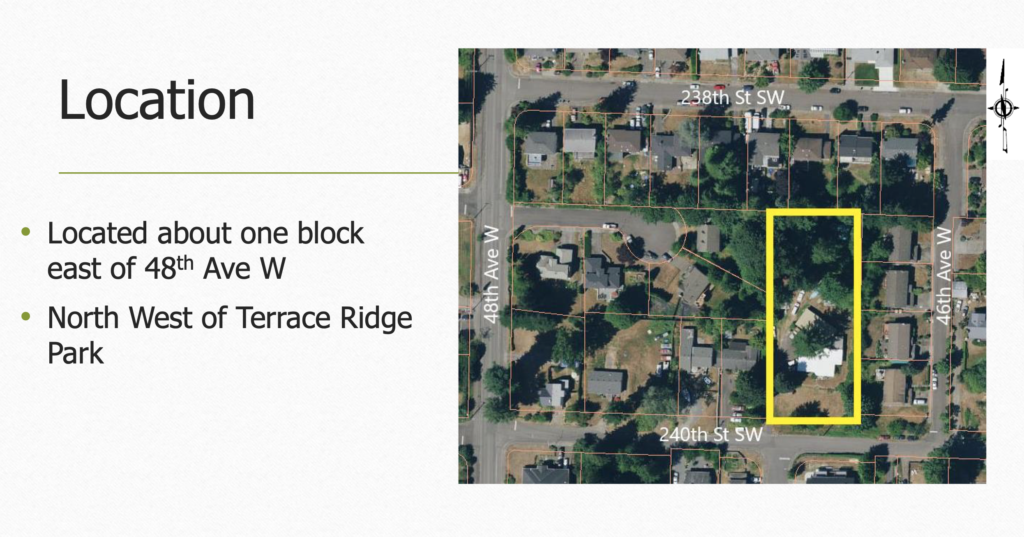
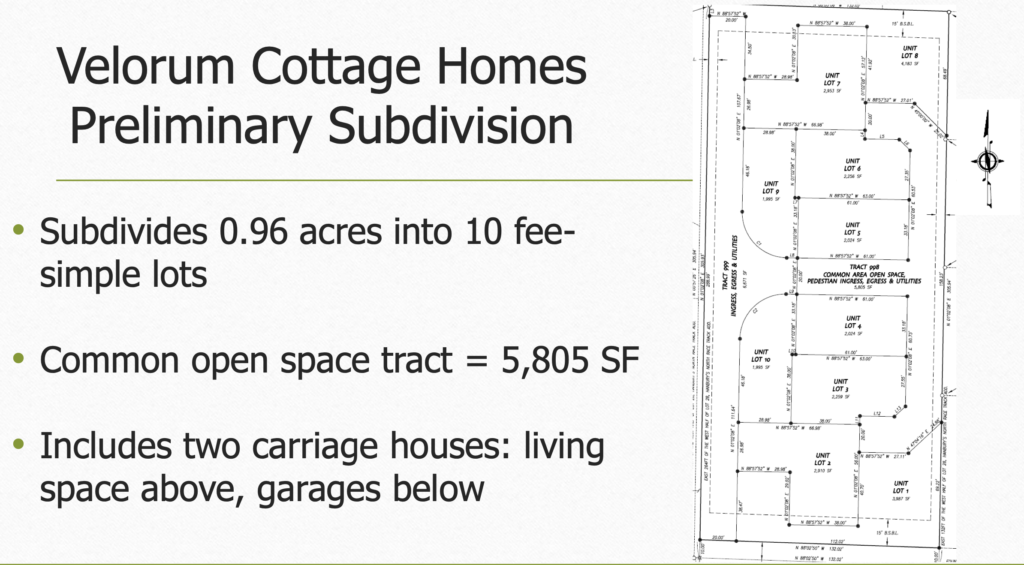
An application has been submitted to redevelop the nearly 1-acre site at 4615 240th St. S.W. with a 10-lot cottage home development. Plans call for eight detached cottage homes and two separate carriage houses that each have living spaces atop three individual garages. Each detached unit would have two parking spaces within a garage and the carriage homes would have one garage parking space and another one in the development’s lot.
The detached homes would feature covered front porches that open onto a shared common open space that includes benches, a covered picnic pavilion and a barbecue for use by the residents. It would also create right-of-way frontage improvements for four to five on-street parking spaces, a planting strip and sidewalk.
Associate Planner Kevin Johnson told the council that cottage home projects require the developer to host a neighborhood meeting to inform nearby residents because they are typically more dense development as far as the number of units on site. He said the developer did so in April 2020 and then “due to COVID the applicant went above the neighborhood noticing requirements and held not only an in-person meeting but also allowed for online submittal of questions, for those who were not comfortable getting together in a group setting at that time.
The Mountlake Terrace Planning Commission previously reviewed the application and recommended it be approved by the council. Mayor Kyoko Matsumoto Wright disclosed before the staff presentation that she was involved in the sale of the property to the cottage developer, but had nothing to do with cottage homes. “I was just the listing agent when he bought it,” she said.
Mayor Pro Tem Doug McCardle said he felt the proposal was “a good project for the city and we always talk about availability of housing and housing choices,” citing the council’s targeting of cottage home developments specifically. However, he added, “my concern again is going to be traffic and parking, noting that the surrounding area “right now seems to be the hotbed of development.”
Johnson said that in contrast to townhome projects, this one does require the creation of additional guest parking spaces on site. The project wasn’t required to conduct a traffic impact analysis because the necessary city threshold for new trips created by the development does not “trigger the threshold” for such a study, he said.
“It’s very nice to see cottage housing happening,” Councilmember Rick Ryan said, noting this would be first project in the city since the council voted to change the zoning overlay areas approximately eight years ago.
A public hearing on the proposal is scheduled for the council’s April 5 regular business meeting.
In other business, Stormwater Program Manager Laura Reed provided a review of rockery repair needed along a section of Hall Creek that is near a private residence in the 6300 block of 213th Place Southwest. That portion of rockery has failed, causing a significant void to open up under the Sellen Construction yard located adjacent to the creek, she said. The void, which is approximately 4 feet wide and 10 feet deep, extends approximately 10 feet horizontally under the property. Steel plates are necessary to prevent people and equipment from accidentally falling into either the void or the creek, she said.
The city is responsible for repair of the rockery in this location under the conditions of a related easement on the private property, Reed explained. Repairs will require the city to design the project, which includes among other environmental concerns a wetland/stream assessment and critical areas reports, and an Endangered Species Act biological evaluation. Reed said the city is unable to design the entire project in-house due to both current work factors and the technical aspects required of the repairs.
As a result, city staff has recommended contracting with Osborn Consulting for the rockery repair’s engineering and permitting work. The not-to-exceed cost for the work necessary to perform the engineering work, produce approved construction drawings, and obtain project permits is nearly $207,000.
Geotechnical, survey, engineering, and design work are anticipated to be completed within six to eight months but permit approval could require a timespan of 12 – 18 months. If the project is able to obtain all necessary permits in a timely manner, then construction is anticipated to take place in the summer of 2022.
City staff has recommended the council approve a work order for this project with Osborn Consulting for the rockery repair’s necessary engineering and permitting efforts. Those repairs would then fix a known problem where the city has responsibility and also reduce sediment inputs in Hall Creek, which can negatively affect local aquatic life and cause channel filling downstream.
Also during the March 11 meeting, the council held further discussions about raising the poultry limits allowed on single-family residential properties in Mountlake Terrace. The request was made by a group of residents last year and then councilmembers initially talked about it last month. At that time, the council asked staff to seek additional community input and also have the city’s animal control officer provide a history of any reports previously received related to poultry, such as noise, odor or rodent complaints.
Municipal code currently limits the number of small domestic animals, such as dogs, cats, hens and ducks, to no more than three on a single-family property. It also describes the appropriate care and environment necessary to minimize nuisances to neighbors and provide suitable conditions for the animals. The group’s request asked for the city to consider raising the allowance of flocks to eight, which the residents wrote “better reflects the needs of a modern poultry keeper.”
Nine poultry-related email complaints were found by the animal control officer over the last five years, which ranged from roosters crowing to stray chickens roaming either on private or public property to an unknown dog having killed chickens. It was estimated that in any one year there may be six to 12 additional complaints that are handled by other officers in the Mountlake Terrace Police Department.
Complaints generally increase over the warmer months when residents are spending more time outside and may have open windows and doors which can lead to noise and odor grievances. Noise complaints are usually due to roosters, which are not allowed under city code. Odor complaints normally stem from the coops themselves. Flock sizes and the structures’ conditions can be difficult to regulate because the enclosures are usually located in backyards not visible from the street, which makes monitoring their conditions, flock sizes and care difficult.
City Manager Scott Hugill told councilmembers that the majority of public comments received since the issue was last discussed have advocated for raising the poultry limit allowed on single-family residential lots. Subsequently, city staff has recommended an increase in the number of poultry that may be kept on those lots, and allowing for more than three hens would also be in line with surrounding cities.
The council expressed their support for the idea, with some asking about the possibility of a registration program. Such a program would most likely be for each residence rather than the individual birds living there, such as is required for other domestic animals like dogs and cats.
Following their feedback, Hugill said he will have city staff put together some initial starting points for further discussion. As part of that process, they will work with community stakeholders on both sides of the issue to outline what would be included in an amendment to the code. This would address not only increasing the number of poultry allowed, but also any potential requirements concerning minimum lot size, noise, odor, rodents and setbacks from neighboring properties.
Hugill anticipated that the council would then have the proposal’s resulting outline to review sometime this summer.
The council on March 10 also further considered the idea of creating two in-house custodial positions for city facilities, a topic it first discussed at its last work/study session two weeks ago. The city currently uses outside contracted groups for cleaning at the police station, operations facility and Recreation Pavilion.
Using city staff for the work would be more expensive than contracting, but staff feel that work is often substandard and results in a lot of turnover in service providers used. Advantages to hiring in-house custodians cited include an uptick in facility cleanliness and also due to current COVID-19 pandemic concerns better risk management and safety. Since the facilities involve providing customer service, they feel that hired staff would be more responsive than contracted workers to any requests or concerns raised at those locations. Also cited were quality factors such as continuity and consistency from having in-house employees, rather than contracted workers who frequently change, which could save staff time of both management and facility maintenance workers.
Most councilmembers said that they recognized both the need for — and advantages of — creating such city positions. A major concern, however, was making sure there is a long-term plan for funding two custodians to ensure layoffs aren’t later required. Some councilmembers also said that economic development and/or communications outreach staff positions should be prioritized before a cleaning crew.
“I wouldn’t bring you any position that I didn’t think we could fund long-term,” Hugill told the council. He said the city typically only lays off or eliminates positions “if there’s a recession or a pandemic,” and “I can confidently say to you we’ve got the dollars identified to be able to fund it.”
He also said that staff have identified a way to fund help for the economic development department and to fill a community relations position. Hugill said he would soon be bringing to the council proposals for their consideration along with the necessary funding identified, adding, “Our economy in Mountlake Terrace is not weak, it is going well.”
Hugill also promised to soon bring the council an updated financial forecast so they can see “the long-term impact of these (custodial) positions on your bottom line,” he said. “And we’ll do that in a conservative manner with a high cost for the service and a low revenue projection for the general fund.”
Councilmembers asked that the city manager also do the same for other potential positions so they can be considered as a whole and then prioritized accordingly. Hugill responded that he also would reach out to the city’s finance committee for their review.
The city council will hold its next regular business meeting March 15, beginning at 7 p.m. See the agenda here.
— By Nathan Blackwell


Real first and last names — as well as city of residence — are required for all commenters.
This is so we can verify your identity before approving your comment.
By commenting here you agree to abide by our Code of Conduct. Please read our code at the bottom of this page before commenting.