
Will you chip in to support our nonprofit newsroom with a donation today?
Yes, I want to support My MLTnews!
Key takeaways
- City councilmembers heard a presentation about the Mountlake Terrace Urban Forest Management Plan, which aims to protect and grow the city’s urban forest over a five- to 10-year period.
- Major findings include a 32% citywide canopy coverage and 73% of the trees in “good” or “excellent” condition.
- The plan outlines five steps to address forestry challenges: Engage, maintain, grow, retain and inform.
- Councilmembers also heard a presentation from city staff about hiring a Chicago-based consulting firm, All Together, to rebrand Mountlake Terrace for economic development.
Mountlake Terrace City Councilmembers on Thursday heard a presentation from city staff about the city’s first Urban Forest Management Plan, which is a blueprint for how the city can protect and grow its urban forests. Mountlake Terrace Environmental Programs Manager Patrick Hutchins said that the plan was one of former Stormwater Program Manager Laura Reed’s “last gifts” to the city before she retired earlier this year.
PlanItGeo Urban Forestry Planner Project Manager Matt Urmson, a consultant on the project, highlighted several key findings from the city’s urban forest:
- There were about 6,830 inventoried (publicly owned) trees with 225 unique species in Mountlake Terrace in 2024.
- 32% of the city is covered by tree canopy.
- 70% of the trees are in “good” condition, 3% are “excellent” and 19% are “fair.”
- 70% of the trees are young with a trunk diameter of 12 inches or smaller. Only 7% of the trees are “old growth.”
“We’re not yet seeing the full ecological benefits that larger trees provide in this population,” Urmson said. “That presents a lot of growth potential, but it also means we need consistent, proactive maintenance to ensure they survive.”
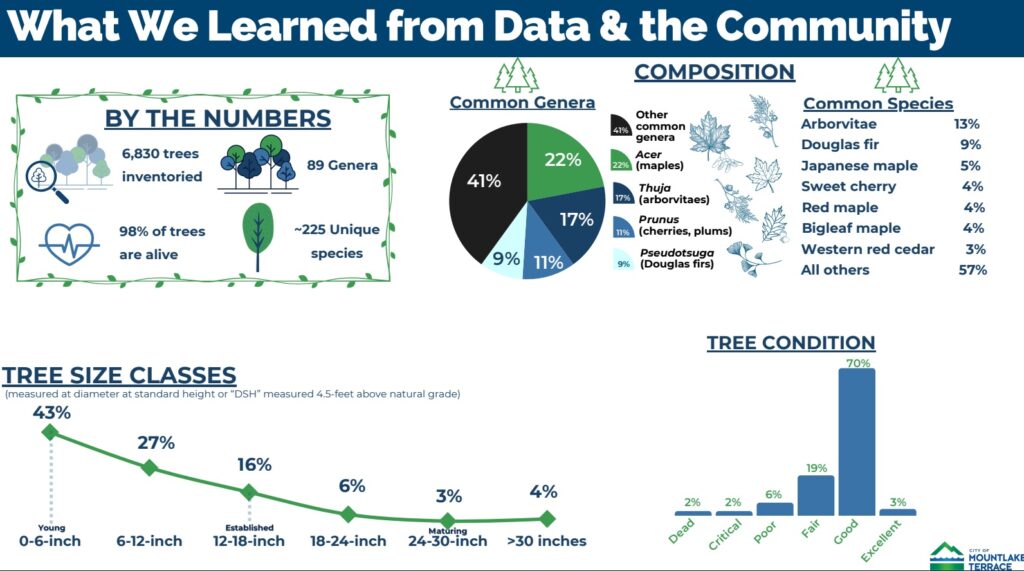
Urmson added that Mountlake Terrace has just two dominant species – maple and cedar – that account for nearly 40% of all trees. “That lack of diversity increases vulnerability to pests, disease and climate stress,” he said.
Urmson identified several invasive animal and plant species that prevent the city from reaching its goal of 37% tree canopy, such as English holly, English ivy, cherry laurel and emerald ash borer. These species can affect land value and the city’s economics.
“Our campaign provides over $2.5 million each year in environmental benefits, return, public health, fire resilience and infrastructure cost savings,” Urmson said. “The street tree population, just a portion of the urban forests, contributes over $121,000 annually in services. [The] bronze birch borer, which is already present in the state, could cause losses of over $75,000 in trees…[and] could result in over $2.5 million in tree value loss if left unmanaged.”
Based on the chart that shows the economic benefits of having urban forests, Hutchins told MLTNews that each of the values is what it would cost the city to provide the same service through some method other than leaving trees as they stand.
“If we lose trees, we’d either not providing a service that community members used to get, or we’d be spending additional budget to make up for the fact that we lost the service from the tree,” he said.
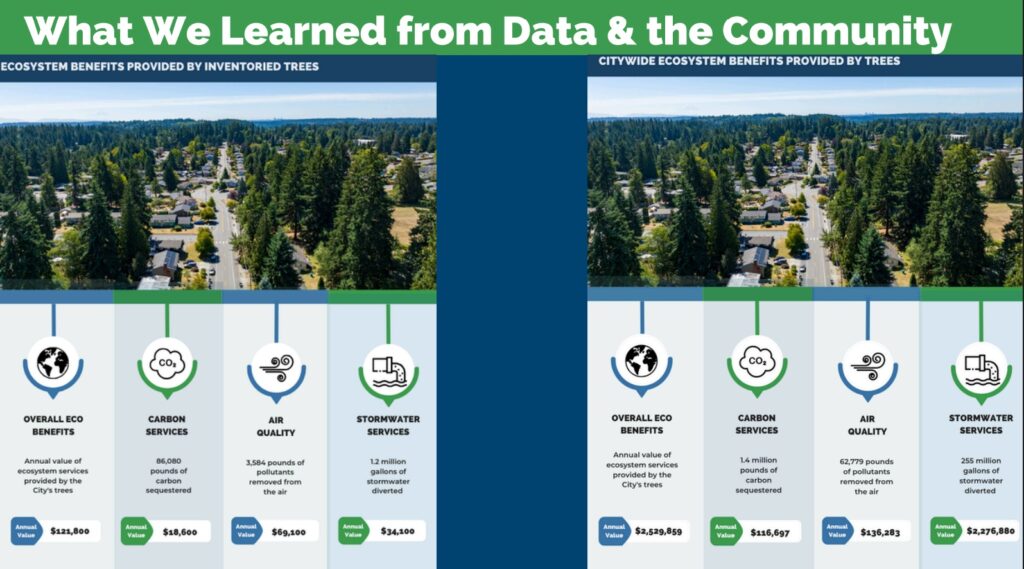
He said each tree pulls a certain amount of carbon dioxide from the air to build its wood each year. Because methods like planting trees, using special rocks to speed up chemical reactions, and other technologies have clear costs for removing set amounts of carbon dioxide, Hutchins can put a dollar value on how much it costs to store each unit of carbon dioxide.
“Then we can calculate how much carbon a tree stores per year with how much a certain unit of carbon costs to store,” he said. “[Let’s] say it costs $100 to store 1 pound of carbon dioxide by other methods, and a tree stores 5 pounds of carbon dioxide each year. That tree would be providing $500 in annual carbon sequestration services.”
According to Urmson, Mountlake Terrace’s urban forestry budget is around $180,000, which is $5.07 per resident in forestry spending. That’s compared to similar cities and Washington state, where the average is about $11.50 per capita. The national average is $12.26 per capita spent on urban forestry, he said.
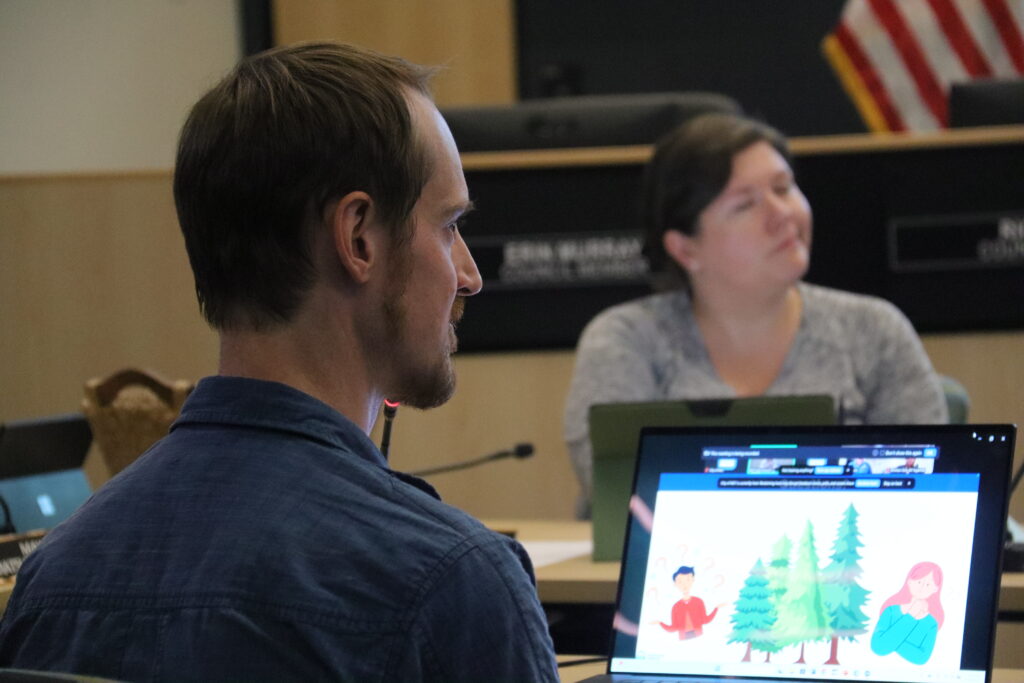
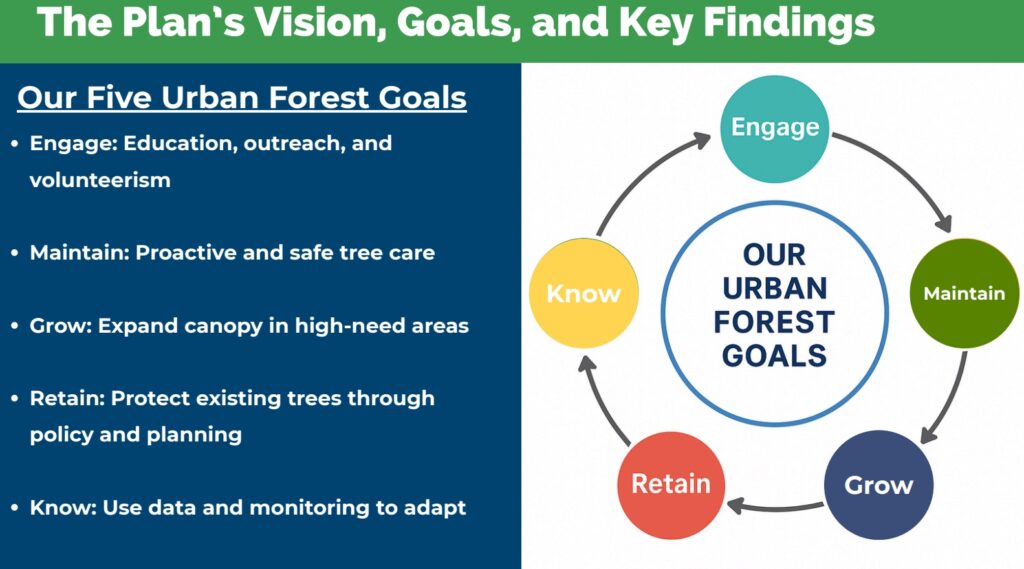
To preserve and grow urban forests, Urmson recommended five goals:
- Engage: Establish tree ambassador and stewardship programs and partner with schools and community organizations
- Maintain: Address existing tree maintenance and improve pruning
- Grow: Plant at least 137 trees a year to meet goals, and focus on planting in areas that are heat-prone and underserved.
- Retain: Strengthen forest and tree protection policies and permitting standards; support property owners with retention resources
- Know: Update tree inventory in real time and canopy data every two years; support transparency with public reporting
Councilmember Laura Sonmore asked how the forestry program would be enforced. Hutchins said that there are already ordinances in place to protect trees that are over a certain diameter.
“Anytime someone wants to remove a tree on a property in the city, they have to go through a full process of assessing the trees, providing information to the city, the city deferring approving that removal,” Hutchins said. “We know that people who live in Mountlake Terrace really care about their trees, and so we think…we can start with an engagement component of working with developers to understand that preserving large trees is critical to people who want to move to Mountlake Terrace.”
Councilmember William Paige asked about the tree equity score, which evaluates and prioritizes areas with the greatest need for tree cover, wondering what it should be in 10 to 20 years.
Urmson said that the city’s current score is 87 out of 100, which is a “pretty good score.” He suggested a priority should be maintaining or planting more trees in underserved communities.
“What is the perfect score is up to the city to determine [based on] what they can maintain and what the community needs,” he said.
Paige also asked how development affects tree canopy growth. Urmson said that it depends on the pace of development, whether clear-cutting occurs, and if alternatives like structural soils or root barriers are used.
Paige suggested the need for a measurable canopy goal – similar to housing or business targets – so it can be tracked within the city’s Comprehensive Plan. He also recommended the city conduct a community survey that focuses on areas that are heat vulnerable and underserved.
Councilmember Erin Murray asked how climate change could affect Mountlake Terrace’s tree canopy and landscaping over the long term. Urmson said that predictive models suggest the city’s climate could resemble Three Rivers, California, within 80 years.
“[We] discuss in the plan about creating the right tree, right place, so [we’re] looking at the trees that are going to thrive in 50 years, and planting them today,” he said. Urmson also emphasized water-efficient landscaping, which prioritizes irrigation for trees instead of turf grass. The forestry management plan includes cost comparisons to show the economic benefits of shifting to more sustainable practices.
~~~~
In other business, Economic Development Manager Ryan Doss and Communications and Community Engagement Manager Sienna Spencer-Markles reviewed a service agreement with a Chicago-based consulting firm All Together for city branding and marketing.
The project aims to enhance Mountlake Terrace’s image, attract investors and boost economic development.
The budget covers a 10- to 12-month timeline divided into three phases and should not exceed $68,920. The council will continue to review the agreement during its Sept. 18 meeting.
Sonmore asked why the city should hire a company that has never visited Mountlake Terrace. Spencer-Markles said that after staff had reviewed 23 proposals from across the U.S., she found All Together to have the “perfect balance between city government, planning, experience, creativity and their creative ideas.”
City Manager Jeff Niten said the branding and positioning the city has now hasn’t really attracted the Town Center development that was envisioned by the City Council as part of rezoning that occurred under the Town Center Plan.
“[We] try to attract new business development for the transit development district that is cohesive. It’s something people automatically recognize and highlight Mountlake Terrace as a unique place to be,” Niten said.
Paige asked All Together brand strategist Kristian Gist, who attended the meeting via Zoom, how many cities the company has worked with that are similar to Mountlake Terrace.
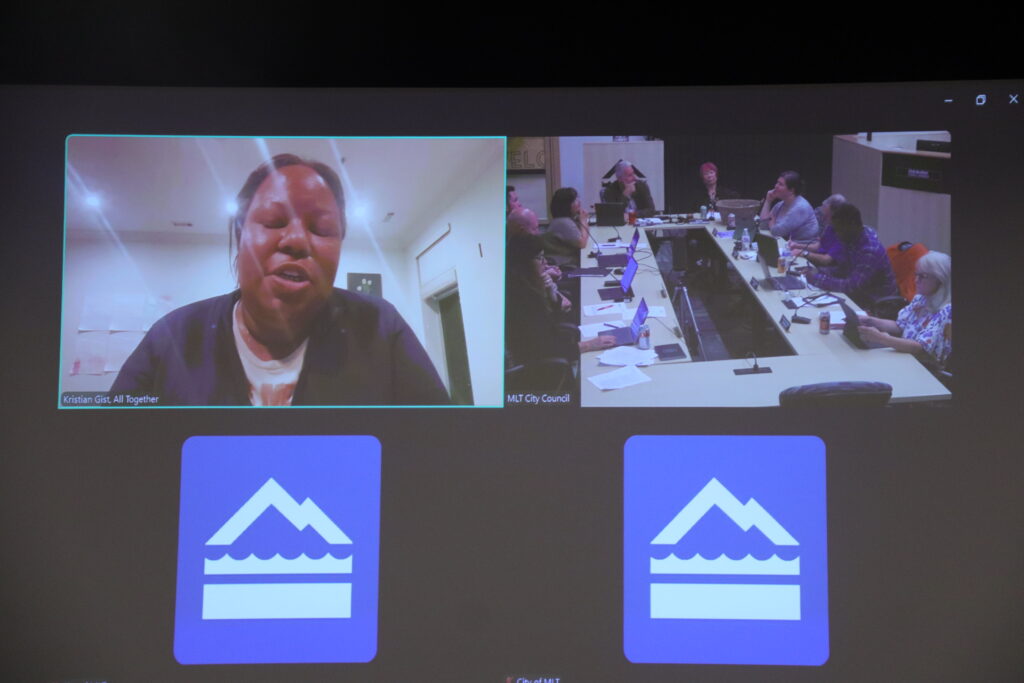
Gist said the company has worked with cities that – like Mountlake Terrace – are close to a rail line and have diverse racial and religious demographics. “We have worked with a lot of cities, a lot of counties and states that are up against [similar] challenges,” Gist said. “If you’re small and you’re authentic, but you want to grow, you want to highlight the stories of everyday community members, residents…”
When Paige asked about what key performance indicators (KPIs) would be used to measure progress, Gist said that the residents they survey should feel that they are included in the process, even if they don’t agree with the final brand. She said the company reaches out to all ages, cultures and community groups via surveys, interviews and public events.
Details on both presentations can be viewed on the city’s website.
Part 2 of the Sept. 11 City Council Meeting on aging public buildings and DEIC report.


Very interesting article. Is there similar information on other South Snohomish Cities?
Yes, Edmonds and Lynnwood each has one.
Edmonds: https://cdnsm5-hosted.civiclive.com/UserFiles/Servers/Server_16494932/File/Government/Departments/Development%20Services/Planning%20Division/Tree%20Code%20Updates/EdmondsWA_UFMP_2019_MidResolution.pdf
Lynnwood: https://www.lynnwoodwa.gov/Community/Play-Lynnwood/Healthy-Lynnwood/South-Lynnwood-Urban-Forestry-Initiative